Thursday, June 14, 2012

The Belly of The Beast

by Jon Egan

I just got back from attending the Book Expo America convention in New York and WOW! What an eye opening experience.

It was completely overwhelming walking through the doors of the Javits Center and into the bowels of the business. Overwhelming and scary, when you see all these authors, publishers, agents, publicists, sellers, buyers, and wow, like I said it’s overwhelming.

How will I ever get to be on the inside looking out when there are so many insiders? Why would anyone ever be interested in reading what I have to write when there are so many proven authors out there already? It was almost like a punch in the gut walking through the halls, and yet at the same time it was pure adrenalin. Intense excitement and extreme hope. Because while I wondered how or who would ever want to publish my stuff, I kept reminding myself that every one of the authors here must have gone through the same wonderment at some stage.

It was great to be able to meander through the publishers’ booths picking up ARC’s at random and having  the publishers almost beg you to take it, and read it, and blog about it, or spread the word about what a great novel it was. Talk about a surreal turn around. So I did just that: I idly stood at some booths and perused their offerings as I would in a bookstore. When I placed some back on the pile, I was asked, “Is there something wrong with it?” “What’s not appealing about it?” Others were immediately stuffed into my backpack and then squirrelled away into the box that Fed-Ex was packing for me on the upper level.

There were over six hundred author signings this year from John Green, Jerry Spinelli, and Spencer Quinn (Patty’s favorite author who she got to meet and chat at length with) to obscure Russian and Middle Eastern authors. Here's what really intrigued me: with all these wonderful authors mingling with the general public, touting their latest greatest tome, the longest lines were for the dude from HGTV’s Holmes on Homes. Yep, the big guy Mike Holmes was there signing. Talk about a war for the ages. It seemed like the biggest WWF tag team match in decades as the Librarians body slammed the Educators while the Agents snuck in the back door to be first in line for his autograph. His line literally snaked around about fifteen booths, which was great because I was able to get in a line of about ten people for a handshake and signed copy of Will Schwalbe’s ARC The End of Your Life Book Club.
Mike Holmes
Will Schwalbe
Patty Egan with author Spencer Quinn
 I’m not saying it’s a bad thing that celebrity for the most part trumps non-celebrity but, actually I am, it kinda stinks but oh well, such is life.


I probably won’t attend another B.E.A. until I’m sitting on the other side of the table, pen in hand, smiling and thanking the eager attendee who’s holding a copy of my latest novel for reading my stuff. (One can dream right?) But if you get the chance to attend, no matter if you are a reader or a writer, you should. It’s definitely an eye opener and a glimpse into the belly of the beast.

Monday, June 11, 2012

Grace & Melissa's Reunion

by Melissa Kline

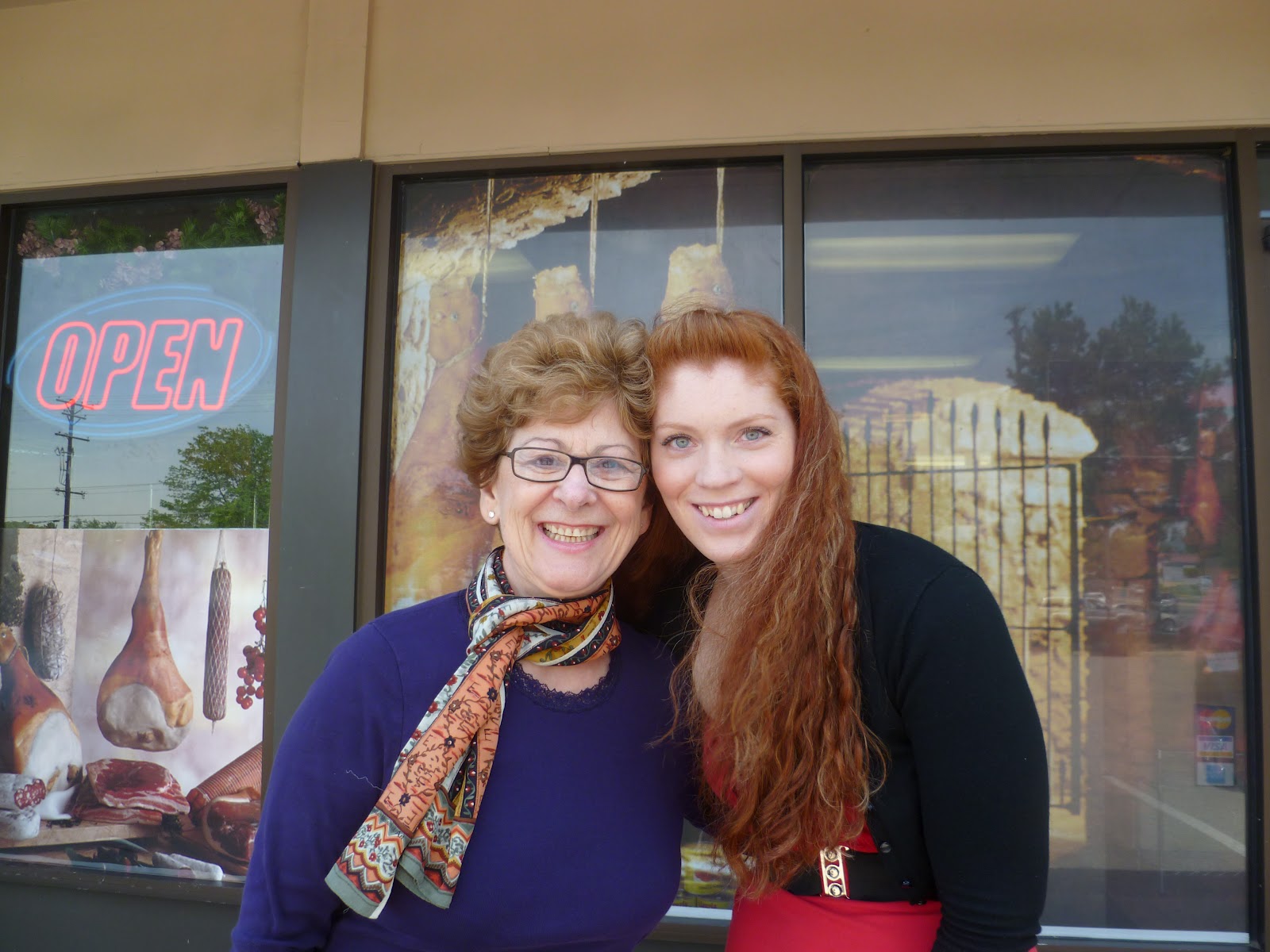
Grace and I met on a breezy afternoon in Denver a couple of weeks ago. I was SO excited to have the opportunity to reunite with a fellow member of the swagger family. What a treat...literally!
Grace invited me to meet her at Deli Italia - a delightful cafe, deli and specialty market in Lakewood, Colorado, which is owned by Grace's brother, Riccardo. 

Upon entering the market, smells of fresh cheese, meats and bread tantalize the senses. The store is beautifully decorated with photographs of Grace and Riccardo's hometown, Luca, and there are murals of gourmet delicacies everywhere! The space is warm, inviting and very unique. There is love in every detail! I especially enjoyed the family portraits proudly displayed in the entryway.
 Grace and I chatted in the spacious seating area whilst traditional Italian music wafted around us. We were served fresh cappuccinos and home-made mozzarella that was quite easily the best cheese I have ever tasted. The mozzarella was a pillowy blob of gooey softness that had an airy, yet melty texture. The taste was even more incredible - salty, rich, nutty. Yum! I felt as if I had been whisked away to another time. It was heavenly.
After lunch, Grace gave me a tour of the store where I spotted her newly released book, "Dancing on Grapes," a children's picture book about Grace's experience growing up in Italy. It was so neat to see her beautiful book on display amongst the fun treats and treasures.
Thank you Grace and Riccardo for indulging me in a slice of true Italian heritage. I am honored!

If you are in the Denver area, don't miss Deli Italia. Treat yourself to some of that amazing cheese! :)  

Thursday, June 7, 2012

The Redwoods : A Writer's Dream Come True

by Regina Gort

My husband and I recently celebrated our 10-year wedding anniversary by taking a trip to the Redwoods.

It was the first time away from our three girls for an extended amount of time. It was the honeymoon we couldn't afford at the time we got married and would haven't truly appreciated then anyway. To even plan the trip was a feat.

But we got there.

We flew into Portland, Oregon and then drove out to the coast and followed the ocean down Highway 1 to the Jedediah Smith Redwood State Park. We stayed at a cabin right on the Smith River.
And every morning we read poetry, wrote and then headed out the door for a 6-mile hike. But nothing could prepare me for seeing the Redwoods. I had seen documentaries and photos. And I knew that they would be big.

But nothing prepared me for the magic.
Being in a forest of giants was beyond words. So much so that I couldn't write about them. I wrote about the ocean, the birds, rocks and even banana slugs.

Never before had I been silenced by such beauty.

That's how I knew I had found a muse. The trees sparked this desire, this longing to hear their words. So instead of trying to capture them, I simply enjoyed them.

The best part is that I brought them home with me. And I will spend my lifetime in the branches of the Redwoods, no matter where I am.


Monday, June 4, 2012

CRITIQUE GROUPS

by Kathy Cannon Wiechman

If you’re a writer, do you belong to a critique group? Should you belong to one?

One person I know recommends writers not join critique groups, though she does like critiques at workshops. She fears that writers might get bad advice from others in a group or that writers might lose confidence in their work if they get a negative critique.

I understand her concerns, but I value my critique groups. In today’s market, a manuscript submission must be as close to perfect as possible by the time it reaches an editor’s desk. I know I get too close to my own work to see it clearly. When I describe a scene I know too well, a reader might not be able to picture it. I need to be told it isn’t coming across clearly enough, so I can rewrite it. If my plot isn’t working or my characters aren’t believable, I need to know that, too.

Belonging to a critique group also requires accountability. If a group is waiting each month to hear/read what you’ve written, it helps keep you in the chair and pounding out the words.

You can avoid the pitfalls of a critique group. First, make sure to join a group that’s right for you. The first one I joined many years ago was not the right group, and I stayed with them for only two meetings. I was the only writer for children in the group, and their critiques tended to feel like a pat on the head. I wanted constructive criticism.

The key word there is constructive. There’s no point in offering a critique that isn’t helpful. I also believe a critique should begin with something positive. Telling a writer what’s working is at least as important as telling her what is not.

And when you’re on the receiving end, it’s important to learn whose advice to listen to and whose to ignore. If you write picture books, a novelist’s advice might not be best. If you’ve been writing for decades, perhaps the advice of a newcomer should be taken with a grain of salt. Sort through the comments you get and use only those which you find helpful.

My two critique groups work in different ways. (Both consist of writers for children; both have published and unpublished members.) The first (which I’ve belonged to for more than 20 years) has members read their work aloud before going around the table for critiques. The second (which I’ve been with for nearly 10 years) has members e-mail their work in advance. We receive the e-mailed ms, print a copy, write a critique, and take it to the meeting for group discussion. Occasionally, a member will bring printed copies of a short piece to a meeting to read and discuss.

Both types of critiquing have pros and cons.

Reading aloud has definite time limitations, and novelists in the group can only read a chapter or two a month, which means it can take years to cover a whole novel. That makes it impossible to judge the work on its flow, and keeping the plot straight over time gets tough. To get around that, we often trade complete novels with other members to read and critique one-on-one.

Reading aloud helps to catch those awkward sentences that trip up the tongue, and overused words become obvious, but a trained voice can make a car manual sound like Gone With The Wind, and some important flaws might be missed.

Reading a written copy lets us see the work as an editor sees it, but reading it in advance loses immediacy by the time it’s discussed at the meeting. And printing all those copies really laps up the paper and ink.

At Rich Wallace’s workshops, he often has us read each other’s work aloud. That gives us the advantage of hearing our own work, instead of reading it ourselves. It can be ear-opening.

Over time, I’ve learned how to get the most from my groups. I have the advantage of knowing whose advice is most helpful, and have made many friends who share the love of words.

My groups also share information on workshops. In 1999, a few group members encouraged me to apply for Chautauqua, and I learned about the Highlights Foundation, which introduced me to the Founders Workshops, where I met the Swaggers. A true plus!

Thursday, May 31, 2012

Versatile/Eclectic Blog Award


Irene Latham awarded Swagger and four other blogs her variation of the Versatile Blog award she received. She dubbed it the Eclectic Blog Award. She says "eclectic" seems more "artsy", like it's "getting to the source of things."

Here are her rules:

  •  Thank the person who gave you this award. That’s common courtesy. 
  •  Include a link to their blog. That’s also common courtesy.
  •  Next, select 5 blogs/bloggers that you’ve recently discovered or follow regularly. 
  •  Nominate those 5 bloggers for the Eclectic Blogger Award — you might include a link to this site. 
  •  Finally, tell the person who nominated you 5 things about yourself. 
So thank you, Irene. We will play now. For our recently discovered or regularly followed eclectic blogs:

Juliet Bond picked The Debutante Ball. This six-year-old blog is run by a group of debut authors. A recent post by Molly Backes talks about the kinds of mementos she likes to keep, and how those things reveal a lot about her character.

Jon Egan and Kathy Cannon Wiechman both selected Rich Wallace's new family blog Active Happiness. It's a collaboration between Rich, his wife Sandra Neil Wallace, and his sister Lynda Wallace. It came into being after this threesome decided to publicly answer the questions they say they've been receiving for years about how they are all so happy despite: getting divorced, being a single parent or step-parent, losing loved ones, and leaving high profile jobs and living on less.

Regina Gort's eclectic blog pick is WIP because we are all works in progress. Rebecca Grabill is raising four kids and writing. She just finished her MBA at Hamline. Regina enjoys the motherhood stories she shares and the book reviews. She says Rebecca struggles just like the rest of us, but has a voice all her own. 

Kim Van Sickler was turned on to Gypsy Ink by editor friend Kate Kyle Johnsen who referred her to this awesome post. Blogger Leanna Tankersley is married to a Navy Seal. She's an author, mother, and workshop and retreat provider. She's very reflective, no matter what the topic, and that gives Kim lots to chew on. (The fact that Kim's married to a (now retired) Army Ranger makes her feel a special kinship to this fellow military wife.)

Rich Wallace nominates Letters of Note as his eclectic blog choice. This ambitious blog publishes historical postcards, letters, faxes, telegrams, and memos like the heart-felt letter author James Baldwin wrote to his 14-year-old nephew decrying the progress made against prejudice in 1963.

Melissa Kline champions Indiepreneur Power, a blog that bills itself as providing "positivity, inspiration and know-how aimed at empowering you to thrive in your unique, authentic, and  inspired livelihood." Recent blog post: How to Jump Off a Mountain!

To fulfill the last requirement, the Swaggers will reveal one interesting factoid about us:

Juliet Bond once danced naked in front of thousands of people in a college production of the musical "Hair".

Kathy Cannon Wiechman was once babysat by Rod Serling of "Twilight Zone" fame.

Jon Egan is alive today despite dying for more than five minutes when he was a teenager. 

Regina Gort collects vintage cookbooks. Her favorite is "The Husband Holder" and includes a recipe for meat cups.

Kim Van Sickler used to sing with the Cleveland Orchestra Children's Chorus.

Rich Wallace is the reigning New England 200-meter track and field champion for 50+-year-old athletes.

Melissa Kline is a miniaturist who uses her modeling skill to create tiny replicas of the people and settings she writes about.

Monday, May 28, 2012

Writers and Their Writing Spaces…Or Spaces of Writers…Or Spacey Writers…Oh, Never mind

by Juliet Bond


There are many reasons why novelists write – but they all have one thing in common: a need to create an alternative world.
John Fowles

Most writers try to carve out a space for themselves.  Virginia Woolf, for example, famously insisted that a woman needs money and a room of her own in order to create fiction.  Ms. Woolf hid herself in a nearby shed on the property of Monk’s House when she wanted to write.


Virginia Woolf’s writing shed

Like Woolf, some may prefer one specific room, desk or corner while others may be flexible or even mobile.  My favorite place to write is the living room in my in-law’s vacation house.  I begin at five AM, before everyone wakes up.  Then, if I’ve caught the muse, and the story comes hurtling forth, I carry a purse-sized notebook with me in the car, at restaurants, to parks – wherever my family is going – and I keep writing.  I write between meals, reading stories to my kids, taking a shower, teaching a class; this works for me. 

Jane Austin wrote amidst the chaos of family interaction too (er, not that I am comparing my writing prowess to Jane Austin, just my ideal setting.) 


Jane Austin’s writing desk at Chawton Cottage

One glance at that tiny chair and table and it’s easy to imagine a busy room of women, stitching, reading, laughing and plonking away at the piano.  For many, the distractions would have made it impossible to concentrate.

But I’ve never been very good at total solitude.

The Pulitzer Prize nominated writer Francine du Plessix Gray wrote, "The whole thing about writing is how to be able to withstand solitude."  For me, withstanding the solitude of writing is so much easier when not alone.

Still, every writer is unique.  D.H. Lawrence preferred to write while sitting under a tree.  Toni Morrison had to shell out cash for a hotel room to nurture her muse.  The venerable Audrey Niffenegger enjoys the white noise of a chocolate scented, local café.  And rumor has it that Gertrude Stein felt most creative in her car while Ben Franklin composed best in the bathtub.

When I poled the Swagger group, most said that they prefer a messy desk, surrounded by the items that comfort or vex them:

·               A coffee cup, not cleaned for three days
·               Pictures of their children for inspiration
·               Poems, quotations or inspiring images on crumpled paper
·               The books that made them want to be writers in the first place (both comforting and infuriating because they are the tantalizing holiest of grails for each individual writer.)


Kathy Weichman’s writing desk

Other writers need a ritual to get them started, slipping out of bed, brewing a fresh pot of coffee and eating a banana maybe.

And some rely on a time of day.

Simone de Beavoir claimed she got bored if she didn’t begin working right away each day.  She then took a break for lunch and socializing, and would resume writing again at five pm.

The luckiest of writers had the money or resources available to create their own ideal spaces for writing.

George Bernard Shaw’s writing shed


Mark Twain’s writing structure


Linda Aldrich’s tree house


Roald Dahl’s writing shed


And then there are artists who celebrate creative spaces by creating art about creative space.  A 2008, New York Times article features a mural by visual artist Elena Climent depicting the rooms of some of the most famous writers including Edith Wharton, Zora Neal Hurston and Washington Irving.


And true literary junkies, (who have a few thousand dollars burning holes through their golden pockets), can essentially stalk their hero’s creative spaces.  One can take a trip to peer through the windows of Hemmingway’s Florida Spanish Colonial or cavort within the tiny rooms at Shakespeare’s childhood home.


If I had a ticket to England I would hijack my friend Barb and drag her to Greenway, a Georgian Mansion where Agatha Christie commissioned an architect to make sure she had, “…a big bath and a ledge because I like to eat apples.”


In the end I suppose it doesn’t matter where a writer writes as long as they are writing.  The place, as fantastic, messy, quiet or chaotic as it may be, isn’t the point.  Writing is about what is produced not where it was produced.  And where a writer writes is as unique to each writer as their own ache to create.  As Anne Lamott said,

We are a species that needs and wants to understand who we are. Sheep lice do not seem to share this longing, which is one reason why they write so little.

So write where you are, wherever that may be.


Thursday, May 24, 2012

Come Fly Away

by Kim Van Sickler

The other night I attended a presentation of Twyla Tharp's Frank Sinatra-inspired fusion of modern dance, ballet, and jazz called Come Fly Away. Using twenty-seven of Frank Sinatra's signature songs, Tharp's choreography tells the story of four couples falling in and out of love from the toe-curling moments of a first kiss to the indifferent look of an ex dangling from someone else's arm.

I was inspired. If Twyla can take twenty-seven Frank Sinatra songs and tell a love story in movement, why can't I take one line from each of those songs and create a comprehensive love story in words? Here's what I came up with.

Here's the last toast of the evening, here's to those who still believe:

I've got a little story you ought to know:
Picture a little love nest,
when our love was new.
I'm your big and brave and handsome Romeo.


That sly come hither stare,
my lean baby, tall and thin.
Yes, you're lovely with your smile so warm.
Yes sir, that's my baby now.

Ain't gonna miss a thing, I'm gonna have my fling.
I want to run and play hide-and-seek.


Did you say I've got a lot to learn?
I'm as awkward as a camel.


Yet you're my favorite work of art.

The cigarettes you light one after another.

There may be trouble ahead;
you might refuse to stay.

A little voice keeps talking to me from way down deep inside.
Why be afraid of it?

You are all I long for.
These vagabond shoes are longing to stay.
I'll gladly surrender myself to you body and soul.

I pick myself up and get back in the race.

I'm gonna make a brand new start of it,
until you're in my arms once more.