by Kathy Cannon Wiechman
(Kathy’s A to Z blog posts are tidbits of fact gleaned from her research for her historical fiction novel LIKE A RIVER.)
Camp Sumter is the real name of the prison camp that history remembers as Andersonville Prison.
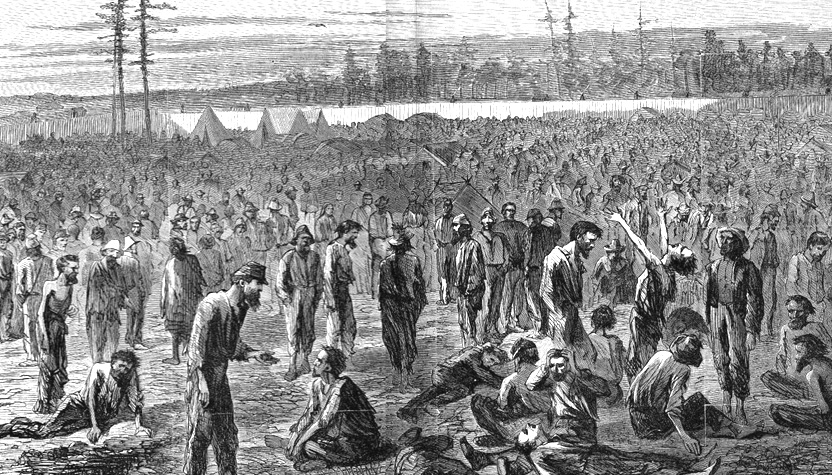
As the American Civil War neared the end of its third year, the Confederacy’s prisons were filled beyond capacity with captured Union soldiers. A new prison was planned near Andersonville, Georgia. Built stockade-style with upright posts of yellow pine, Camp Sumter’s first prisoners arrived in February, 1864, before it was fully completed.
Intended to hold 10,000 prisoners, its numbers reached a peak of about 33,000 in August, 1864. More than 45,000 men passed through those gates to hell.
Prisoners often slept in makeshift shelters that offered little protection from the elements. They were underfed, and medical care was poor.
By the time the last prisoners were released from Camp Sumter in March, 1865, its cemetery and burial trenches held at least 13,000 bodies. Many men who had survived horrific battles took their last breaths inside the prison’s unforgiving walls. Sometimes deprivation and disease were a more formidable foe than shot and shell.
Thursday, April 3, 2014
Wednesday, April 2, 2014
B is for Boston Cemetery
by Kim Van Sickler
[Kim's posts will all relate to her MG historical fiction novel with a paranormal twist: Muleskinner. Here's the pitch: An extraordinary canal dog gives twelve-year-old mule driver, Clay, the conviction to fight against a highly suspect Indenture agreement his pa supposedly signed...right before Pa was found swinging from a tree above Lonesome Lock.]
Superstition abounds surrounding the Boston cemetery, which is visible from the Ohio-Erie Canal abutting the old Boston Village (now Boston Mills), in Summit County, Ohio. During the Ohio Canal Era (1826-1913), many of the folk who helped dig the canal, lived along the canal, and worked on the canal believed the tales they heard about the cemetery. For instance, that voices coming from the Boston Cemetery were spirits looking for company, who would drag you underground if you dared to enter.
The Boston cemetery plays a crucial role in Muleskinner. Not only is it a foreboding place that all the boats pass during their Cleveland to Akron routes and back again, but it is where the mysterious dog, Lucky, first reveals himself to Clay, and digs up a tin box holding clues to Clay's past. It's also the last place we see Lucky.
Here's a description of the cemetery from Muleskinner:
The Boston cemetery was the final resting ground for many of the souls who perished on the Ohio Canal. Rumor was the notorious counterfeiter Jim Brown was buried here. But many of the men whose bodies lay crumbling underground died of diseases like malaria and cholera. Some died in tragic accidents; others from too much drink, and a few, it was well known, were murdered. Clay didn't want to run into any angry spirits looking to avenge their untimely deaths. Not only that, but talk was Injuns were buried there first. Clay never could walk by without feeling spooked. If they passed after dark, Owen left the bow of the boat to walk past the cemetery with him. Cap'n never peeped a word of complaint. Not after Ruby laid into him years ago about how if Cap'n insisted on hauling after dark, Clay should have company passing this ghostly place.
[Kim's posts will all relate to her MG historical fiction novel with a paranormal twist: Muleskinner. Here's the pitch: An extraordinary canal dog gives twelve-year-old mule driver, Clay, the conviction to fight against a highly suspect Indenture agreement his pa supposedly signed...right before Pa was found swinging from a tree above Lonesome Lock.]
Superstition abounds surrounding the Boston cemetery, which is visible from the Ohio-Erie Canal abutting the old Boston Village (now Boston Mills), in Summit County, Ohio. During the Ohio Canal Era (1826-1913), many of the folk who helped dig the canal, lived along the canal, and worked on the canal believed the tales they heard about the cemetery. For instance, that voices coming from the Boston Cemetery were spirits looking for company, who would drag you underground if you dared to enter.
| Boston cemetery |
The Boston cemetery plays a crucial role in Muleskinner. Not only is it a foreboding place that all the boats pass during their Cleveland to Akron routes and back again, but it is where the mysterious dog, Lucky, first reveals himself to Clay, and digs up a tin box holding clues to Clay's past. It's also the last place we see Lucky.
Here's a description of the cemetery from Muleskinner:
The Boston cemetery was the final resting ground for many of the souls who perished on the Ohio Canal. Rumor was the notorious counterfeiter Jim Brown was buried here. But many of the men whose bodies lay crumbling underground died of diseases like malaria and cholera. Some died in tragic accidents; others from too much drink, and a few, it was well known, were murdered. Clay didn't want to run into any angry spirits looking to avenge their untimely deaths. Not only that, but talk was Injuns were buried there first. Clay never could walk by without feeling spooked. If they passed after dark, Owen left the bow of the boat to walk past the cemetery with him. Cap'n never peeped a word of complaint. Not after Ruby laid into him years ago about how if Cap'n insisted on hauling after dark, Clay should have company passing this ghostly place.
Tuesday, April 1, 2014
A is for ANDERSONVILLE
by Kathy Cannon Wiechman
(Kathy’s A to Z blog posts are tidbits of fact gleaned from her research for her historical fiction novel LIKE A RIVER.)
Andersonville is a tiny town not far from Columbus, Georgia. It still looks much as it did 150 years ago, when it became known for the infamous prison camp that was built nearby.
A monument stands in an Andersonville street that is dedicated to the commandant of the prison. Captain Henry Wirz was tried, convicted, and hanged for atrocities committed there. The Daughters of the Confederacy believed Wirz was a scapegoat, and documents exist which back them up. In 1909, they erected the monument.
The town also has shops and museums, where one can find historical relics and documents. There are bills of sale for slaves alongside letters written by Civil War officers. It’s a treasure trove for a history buff like me.
(Kathy’s A to Z blog posts are tidbits of fact gleaned from her research for her historical fiction novel LIKE A RIVER.)
Andersonville is a tiny town not far from Columbus, Georgia. It still looks much as it did 150 years ago, when it became known for the infamous prison camp that was built nearby.
![]() |
| Wirz monument |
![]() |
| Andersonville Visitor Center & Museum |
The town also has shops and museums, where one can find historical relics and documents. There are bills of sale for slaves alongside letters written by Civil War officers. It’s a treasure trove for a history buff like me.
Wednesday, March 26, 2014
RESEARCH
by Kathy Cannon Wiechman
Writing historical fiction means doing a ton of research. And I love researching! I find historical facts, places, and events against which to set my fictional story.
My recently completed novel, LIKE A RIVER, will be published soon by Boyds Mills/Highlights Press. It’s a Civil War story with a few elements the average reader might not be familiar with. It’s also a story about hardship. And triumph. And people.
My research included stops in six states. I visited dozens of intriguing sites and met numerous helpful people. I learned to load and fire a muzzleloader. I talked to experts and read stacks and stacks of books. I learned a lot of facts.
There were “ah ha!” moments that helped mold my story line. And interesting facts that gave me a new perspective on lives lived 150 years ago.
Many of them will not be in the novel. Some of them were things I needed to learn to get a feel for the place and time I was writing about.
Swagger Writers will participate in the A to Z blog challenge during the month of April. I plan to use my portion of alphabet letters to share some of the facts behind the fiction in my book. I hope you’ll revisit this blog next month to read about them.
Writing historical fiction means doing a ton of research. And I love researching! I find historical facts, places, and events against which to set my fictional story.
My recently completed novel, LIKE A RIVER, will be published soon by Boyds Mills/Highlights Press. It’s a Civil War story with a few elements the average reader might not be familiar with. It’s also a story about hardship. And triumph. And people.
My research included stops in six states. I visited dozens of intriguing sites and met numerous helpful people. I learned to load and fire a muzzleloader. I talked to experts and read stacks and stacks of books. I learned a lot of facts.
![]() |
| Kathy firing a muzzleloader. |
There were “ah ha!” moments that helped mold my story line. And interesting facts that gave me a new perspective on lives lived 150 years ago.
Many of them will not be in the novel. Some of them were things I needed to learn to get a feel for the place and time I was writing about.
![]() |
| Confederate prisoner-of-war camp at Andersonville. http://www.classroomelectric.org/ 30,000 soldiers were crammed into an area designed to accommodate 10,000. |
Wednesday, March 19, 2014
REVISIONS
by Kathy Cannon Wiechman
I recently finished “final” revisions of my MG historical fiction novel LIKE A RIVER, and am working on a new novel. Revisions are my favorite part of the process.
Beginning a new novel is tougher. Developing characters, plotting out a storyline, researching real settings and creating fictional ones, and writing scenes are like building a house from scratch.
Revising is like turning that house into a home. The characters need to be fleshed out more, and their motives clearly portrayed. Sometimes a character needs to be eliminated, which can cause other parts of the plot to unravel. The plot’s holes need to be patched, and the settings’ details need to be refined. New scenes need to be added, others deleted. It’s work, but it’s work done on an existing structure.
Before I sent LIKE A RIVER to my editor, I revised it several times—thoroughly. It was finally to a point where I was happy with it. Or so I thought.
The editor took it to the editorial committee and they “loved it.” I was sent a list of revisions to make. That list made me see my story through a new set of eyes. And, as I revised, I saw the novel getting better.
When I was about halfway through those revisions, my editor sent a few suggestions from another member of the editorial committee, so I went back to the beginning and revised some more. I didn’t mind, because people were excited about my story and I could see it improving.
Those revisions were sent off, and I was offered a contract. Yay!!! (Much happy dancing and celebrating done.) After I signed the contract, I was sent a list of suggestions for final revisions. If you haven’t been through this process, it’s extremely helpful. I get so close to my work that I don’t always see weaknesses that others can. Parts of the novel were “too quiet.” I needed to ramp up the tension.
I toiled and tinkered and finished those revisions and made a few other alterations. I made the “last” change on a Friday morning. I emailed my editor to tell her I would proofread it over the weekend and send it the following week. It was still two weeks before the deadline in my contract.
But the proofreading didn’t go as planned. I found words and sentences and paragraphs that I knew could be better. I spotted places that I was no longer completely happy with. This book is going to be published, and the form it takes will depend on what changes I chose to make. It took me a full week to get it to a point I was happy with. I sent it off eight days before my deadline.
The final work received a “good job” from my editor, who is sending it to copy editing. I am sure I will hear from the copy editor somewhere down the road about some final tweaks.
But now I work on this new novel. I am back to that stage of building a house from scratch. I’m glad to have that difficult new work to focus on. If I didn’t, I’d think about LIKE A RIVER, and I am certain I would think of more changes I could make. As human beings, we can never achieve perfection. We try to get as close as we can, but we have to reach a point of letting go.
I remind myself that three sets of revisions ago, an editorial committee loved it. I know I could tinker with it forever, but it’s time to set it out into the world for readers to make up their own minds. Hopefully, they will find it a smooth read that doesn’t show all the work that went into it.
Jane Yolen once told me that when each of her books is published, she holds the book, maybe even smells it, but she never, ever reads it. If she did, she would likely want to revise it some more.
It’s time to let LIKE A RIVER flow.
I recently finished “final” revisions of my MG historical fiction novel LIKE A RIVER, and am working on a new novel. Revisions are my favorite part of the process.
Beginning a new novel is tougher. Developing characters, plotting out a storyline, researching real settings and creating fictional ones, and writing scenes are like building a house from scratch.
![]() |
| Civil war soldiers crossing the Ohio River from Cincinnati, Ohio to Covington, Kentucky. wwwcivilwarobsession.com |
Before I sent LIKE A RIVER to my editor, I revised it several times—thoroughly. It was finally to a point where I was happy with it. Or so I thought.
The editor took it to the editorial committee and they “loved it.” I was sent a list of revisions to make. That list made me see my story through a new set of eyes. And, as I revised, I saw the novel getting better.
When I was about halfway through those revisions, my editor sent a few suggestions from another member of the editorial committee, so I went back to the beginning and revised some more. I didn’t mind, because people were excited about my story and I could see it improving.
![]() |
| Post-Civil War sinking of the S.S. Sultana. America's Titanic? www.strangehistory.org |
I toiled and tinkered and finished those revisions and made a few other alterations. I made the “last” change on a Friday morning. I emailed my editor to tell her I would proofread it over the weekend and send it the following week. It was still two weeks before the deadline in my contract.
But the proofreading didn’t go as planned. I found words and sentences and paragraphs that I knew could be better. I spotted places that I was no longer completely happy with. This book is going to be published, and the form it takes will depend on what changes I chose to make. It took me a full week to get it to a point I was happy with. I sent it off eight days before my deadline.
| Child soldier in the Civil War. the.civilwarparlor.tumblr.com |
But now I work on this new novel. I am back to that stage of building a house from scratch. I’m glad to have that difficult new work to focus on. If I didn’t, I’d think about LIKE A RIVER, and I am certain I would think of more changes I could make. As human beings, we can never achieve perfection. We try to get as close as we can, but we have to reach a point of letting go.
I remind myself that three sets of revisions ago, an editorial committee loved it. I know I could tinker with it forever, but it’s time to set it out into the world for readers to make up their own minds. Hopefully, they will find it a smooth read that doesn’t show all the work that went into it.
Jane Yolen once told me that when each of her books is published, she holds the book, maybe even smells it, but she never, ever reads it. If she did, she would likely want to revise it some more.
It’s time to let LIKE A RIVER flow.
Monday, March 10, 2014
Wormfest: Are you hungry?
by Kim Van Sickler
Today is the Wormfest blogfest, hosted by Stephen Tremp, L. Diane Wolfe, and Alex J. Cavanaugh.
The rules:
Name one thing where science advances mankind, and one where technology with unforeseen consequences will go too far and set mankind back. (And they can be the same thing.) Example: De-Extinction, or bringing back extinction species through back breeding, genetic engineering, and cloning. With all the breakthrough discoveries mankind is on the cusp of, are we playing God?
My choice: packaged foods
Pros
Isn't it great that we aren't utterly dependent on growing everything we eat anymore! So what if there is a potato famine! We'll just eat something else. We can eat something fast and sometimes even semi-nutritious, and get on with our lives. One of my favorite breakfasts before I hit the gym for a morning workout is Greek yogurt and an energy bar. Yum.
Cons
Low-quality processed foods are generally cheaper than fresh foods, but many are pumped full of chemicals and ingredients that aren't good for you: trans fats, sugar, salt...the list goes on and on. Some people eat far too much of it (not to mention the close cousin: fast food) and their heath takes a beating in the form of high blood pressure, diabetes, obesity, heart problems, etc., etc. You could eat packaged foods all day long: Pop Tarts for breakfast, Hot Pockets and canned pears, washed down with a fruit punch for lunch, Cheese Whiz and crackers for a snack, Dinty Moore Beef Stew chased with a Coke for dinner and Twinkies for dessert. Uh. Yuck.
It's too easy for some people (can you say college students?) to go the quick, easy, and cheaper route, when we all REALLY know that for the best energy level, mental acuity, and overall health benefits, you've GOT to eat fresh, unprocessed food too!
Wednesday, March 5, 2014
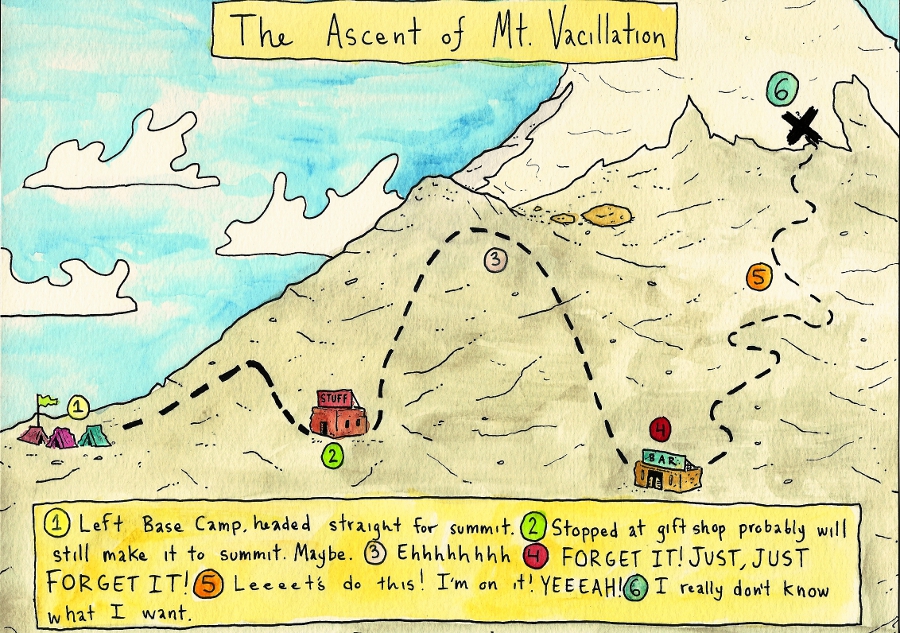
Mount Vacillation
by Kim Van Sickler
This post is part of the first-Wednesday-of-the-month IWSG. Read more about it here.
Rather than focus on writing my break-out novel, I've been vacillating. Maybe that's what happens once you've written four novels that you feel should be somewhere besides your computer hard drive by now. (Okay two of them shouldn't be, but two should be.)
I've actually had a bit of fun writing a slew of short stories lately. In January, I wrote two short stories for the Highlights Magazine fiction contest AND an adult story for the Chicago Tribune's Nelson Algren short story contest. In February I wrote two adult short stories for Glimmer Train while I sat by my Mom's hospital bedside. Now that it's March, I've started revising my MG historical fiction novel and am determined to finish it before the month is out.
And I've been reading a lot so far in 2014: Robinson Crusoe, Steering Toward Normal, Before You Break, Tenth of December, Boy in the Twilight: Stories of the Hidden China, Tampa, and Divergent.
But all of this literary activity can't quite fool me into forgetting that it's time to start writing a new book. Either that, or dust off one of my earlier attempts and basically re-write it. I've been waiting for that little spark to show me the way. So far, no spark. I'm going to have to light my own fire.
Do you ever have trouble deciding which book you want to spend the next [insert appropriate number of months here] creating, nursing, mulling, dreaming?
This post is part of the first-Wednesday-of-the-month IWSG. Read more about it here.
Rather than focus on writing my break-out novel, I've been vacillating. Maybe that's what happens once you've written four novels that you feel should be somewhere besides your computer hard drive by now. (Okay two of them shouldn't be, but two should be.)
![]() |
| http://www.cheeseburgersinthesky.com/2010/06/21/vacillation/ |
And I've been reading a lot so far in 2014: Robinson Crusoe, Steering Toward Normal, Before You Break, Tenth of December, Boy in the Twilight: Stories of the Hidden China, Tampa, and Divergent.
But all of this literary activity can't quite fool me into forgetting that it's time to start writing a new book. Either that, or dust off one of my earlier attempts and basically re-write it. I've been waiting for that little spark to show me the way. So far, no spark. I'm going to have to light my own fire.
Do you ever have trouble deciding which book you want to spend the next [insert appropriate number of months here] creating, nursing, mulling, dreaming?
Subscribe to:
Posts (Atom)